
Quokkas
He's a happy, happy guy, just a happy happy happy guy
After the events of this weekend (ed. note: a reminder that you can support Minnesota orgs here. Also ICE and DHS are not limiting their actions to MN - they’re ramping up activities in Maine; information and organizations to support here. If there are any other resource sites that should be shared, let me know!), I could really use not only some eyebleach but really some soul bleach. Enter the quokka, because JUST LOOK AT THEM. It is truly impossible to both look at them and feel bad.
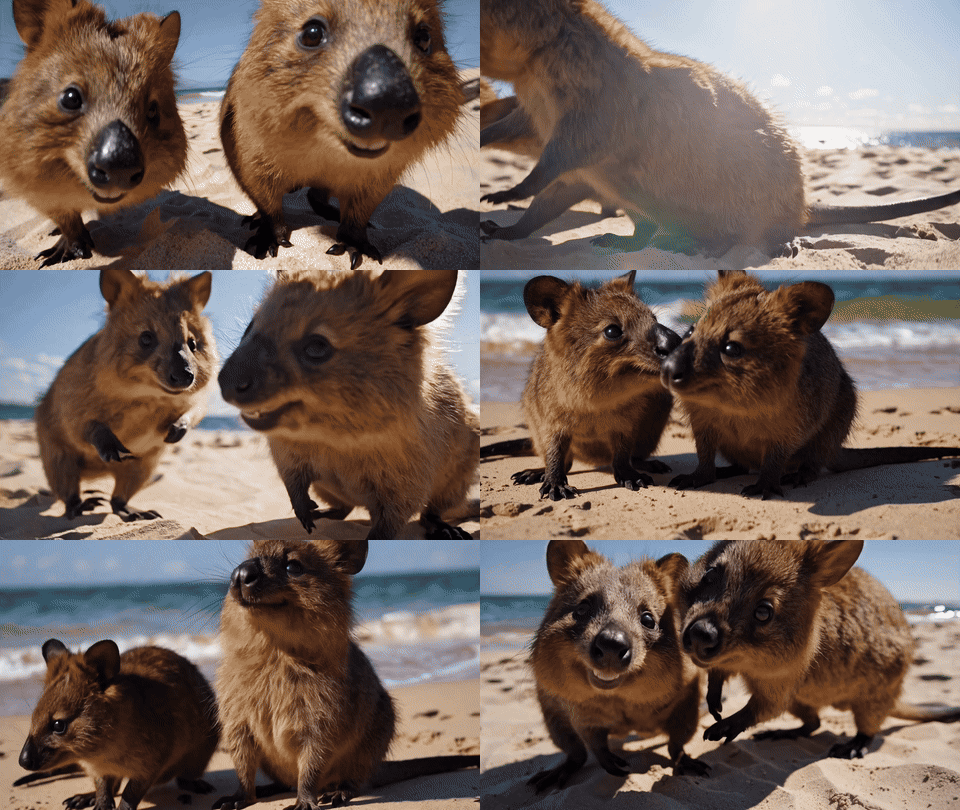
Though they inhabit all of my heart, quokka’s actual territory is very limited to just a tiny sliver along Australia’s southwestern coast and nearby islands, specifically the small island of Rottnest, where two-thirds to three-quarters of the current quokka population lives and which is named after them by a Dutchman who thought they were rats and literally named their island ‘rat’s nest’ (rude). As is so often the case, colonialists screwed everything up - quokkas were all over southwestern Australia until not locals introduced the red fox and the red foxes and cats nommed them up like popcorn and reduced their territory by half in a matter of years. Fortunately for quokkas, their predators aren’t proficient enough swimmers to make it to the islands and they continue to thrive there.

Almost all animals endemic to Australia seem to fall into one of two categories: marsupials and animals that will kill you (have not yet found a marsupial that will kill you). Quokkas fall into the first category. Unlike kangaroos, which can nurse more than one joey at a time with their specialized age-appropriate nipples, quokkas give birth twice a year and pouch their joeys for six months at a time (plus two more months of non-pouch breastfeeding), so there’s not a lot of competition. Also, females mate soon after giving birth, but can keep the new embryo in a state of suspended gestation until her body figures out if the first joey is gonna survive or not (!!). Also, if a momma quokka is threatened while she’s pouching a joey, sometimes she’ll drop the joey as a distraction while she escapes. They cute but they are ruthless.

Though some websites refer to quokkas as wallabies and they’re in the same family (Macropodidae), they’re only one species and the only species in their genus so - by my calculations - quokkas are related to wallabies but are not actually wallabies. They have the tail, sure, and they locomote by bounding and hopping, and are generally kinda nocturnal. However, they don’t use their tail like a tripod (fat storage only, like me), and they’re pretty small but swol - well less than two feet long and up to 11 pounds, they’re about the same size as a housecat.

Quokkas are herbivores and mostly eat grasses, leaves, sedges, and succulents. They need a lot of water to survive, preferring areas that get at least two feet of rain a year (about the same as San Francisco; this is actually less than one might think and reflects a semi-arid climate). Rottnest Island does not have a lot of fresh water so they get most of their water from the vegetation they eat. Like cows and some male humans, they don’t spend a lot of time initially chewing their food; instead, they snarf down their food, digest it a bit, and then chew the cud. Their gut bacteria biome most reflects that of sheep!

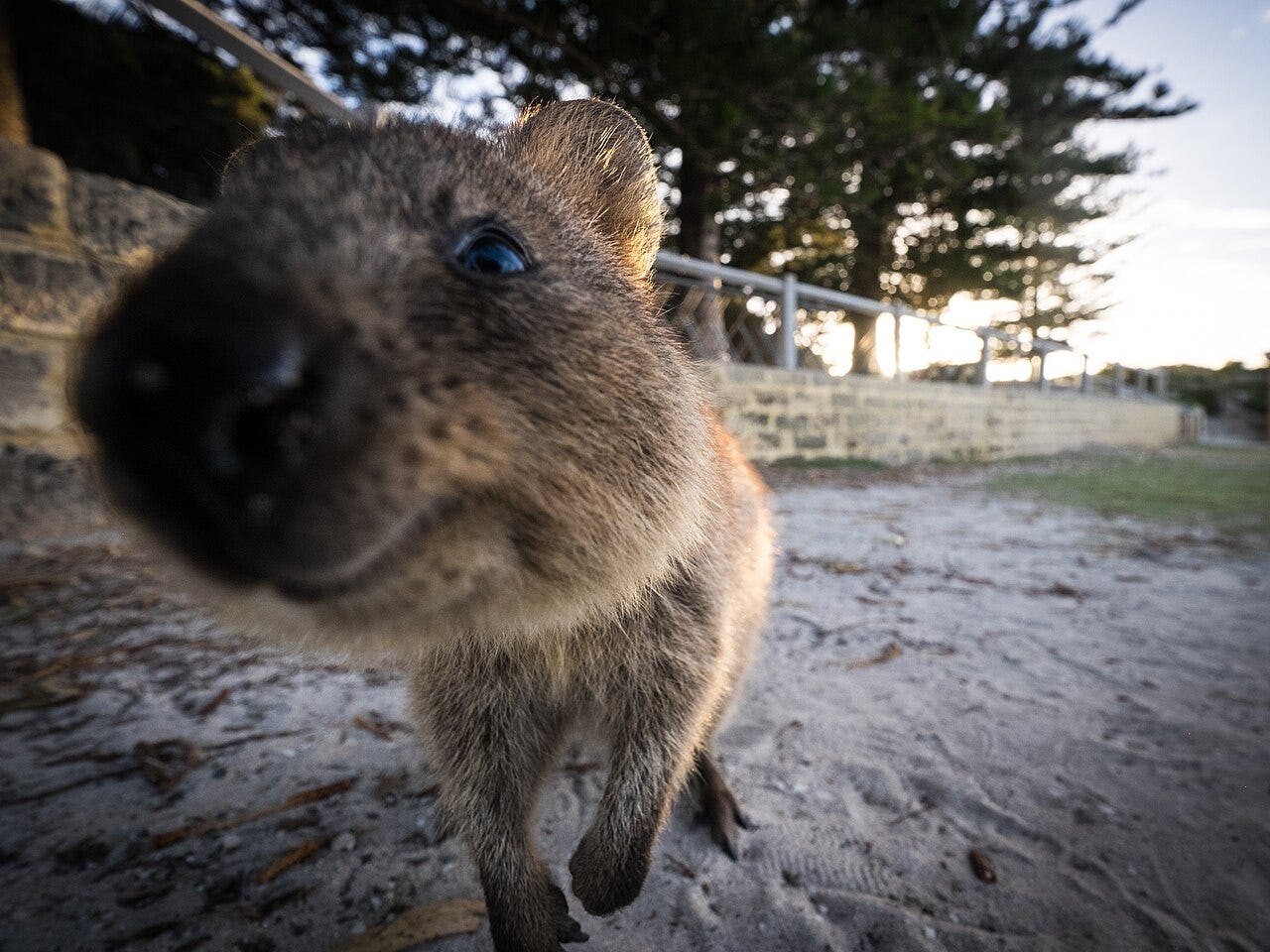
All the smiling selfies with quokkas are not really a coincidence. Sure, the smile is mostly a function of quokka cheeks and big front teeth, but — despite the nastiness that humans have wrought upon them (see: the foxes) — quokkas are generally friendly and curious toward humans. No tranquilizers required for selfies here, they volunteer! However, feeding quokkas is very much unadvised because fun human foods like chips can not only dehydrate but mess up their carefully calibrated guts - Doritos are the easiest way to get a quokka sick. I would say that the best interaction with quokkas is to play ‘quokka’ in Scrabble which would net a remarkable 24 points even before any bonuses but there’s only one k in a standard Scrabble pack!

So cute! Donated to Tending the Soil. Thanks for spreading the good word. I'm a friend of Patti's. :-) Shannon